


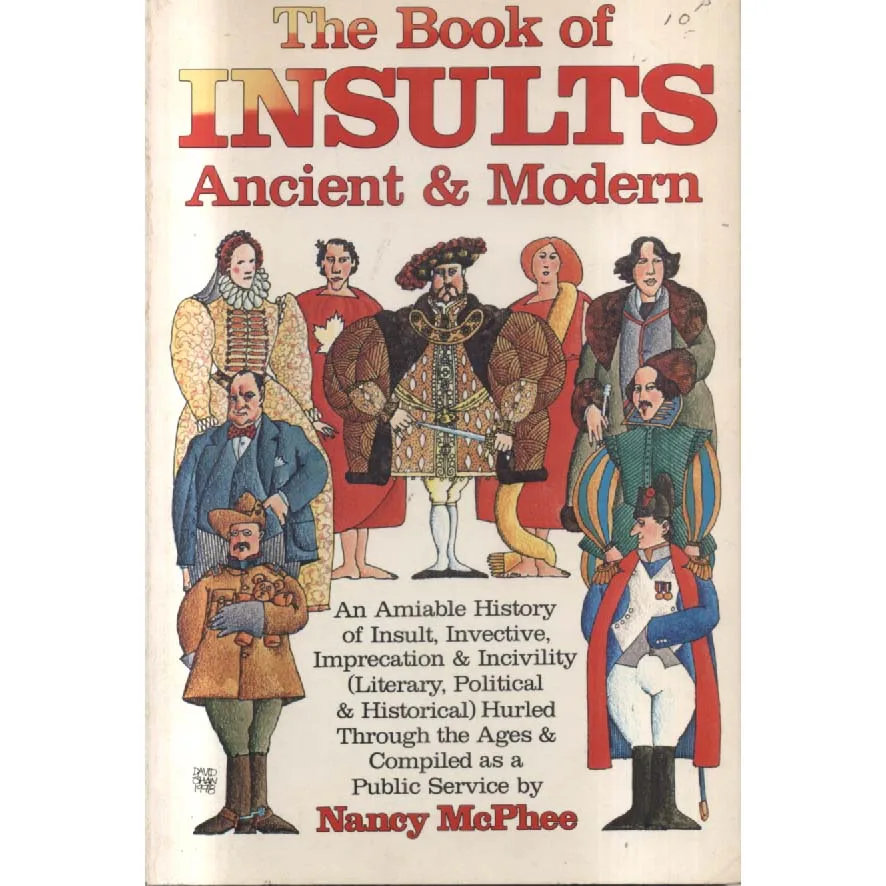
The Book Of Insults - Ancient And Modern
Publisher: Paddington Press
Format: Paperback
ISBN: 0709205228
The Book of Insults – Ancient and Modern (1978) by Nancy McPhee
Paddington Press | ISBN: 0709205228 | Condition: Good
There was a time when insulting somebody was considered an art form, requiring wit, intelligence, imagination and a reasonably comprehensive understanding of the English language. Today, of course, the entire process has been simplified to the point where a person can offend several thousand strangers before breakfast using nothing more sophisticated than a mobile telephone and an exceptionally limited vocabulary. Fortunately, The Book of Insults – Ancient and Modern by Nancy McPhee takes us back to a more civilised age, when a well-constructed insult could demolish a reputation, terminate a friendship or provoke a duel without necessarily requiring the use of a single four-letter word.
Published by Paddington Press in 1978, this splendidly entertaining collection celebrates humanity’s extraordinary ability to express contempt for its fellow creatures. From the ancient world to comparatively modern times, the history of civilisation has been accompanied by an apparently inexhaustible supply of people who disliked one another intensely and possessed sufficient linguistic talent to make their feelings memorable. Philosophers, politicians, writers, aristocrats, entertainers and other supposedly respectable individuals have all contributed to this noble tradition, demonstrating that personal abuse is one of the few activities in which the educated classes have consistently managed to distinguish themselves.
An effective insult is a remarkable thing. It can reduce a pompous individual to silence, expose a hypocrite, puncture an inflated ego or make an enemy appear ridiculous in the space of a single sentence. Unlike physical violence, which tends to involve unpleasant complications with the police, a carefully delivered verbal assault can achieve devastating results while allowing the perpetrator to remain comfortably seated with a glass of something agreeable.
The greatest practitioners of the craft understood that the secret was not simply to be offensive, but to be entertainingly offensive. Anyone can call somebody an idiot. It requires rather more imagination to construct an observation so exquisitely devastating that even the victim’s closest friends are obliged to suppress a smile. The very best insults possess a curious quality of immortality, surviving long after the original quarrel has been forgotten and the participants have been safely buried.
Indeed, history sometimes remembers distinguished individuals less for their achievements than for the magnificently unpleasant things they said about their contemporaries. A politician may spend forty years in public service, introduce important legislation and oversee enormous national developments, only to discover that posterity is chiefly interested in the occasion upon which he described a parliamentary opponent as possessing the intellectual capabilities of a damp cabbage.
Writers have traditionally been particularly accomplished in this respect, perhaps because they spend so much of their lives observing human folly and developing an extensive vocabulary with which to describe it. Literary history is littered with feuds, rivalries and spectacular exchanges of abuse, often conducted by individuals who publicly professed their devotion to the highest ideals of civilisation while privately regarding their professional competitors as barely competent organisms.
The ancient world was hardly more charitable. Greek and Roman society produced some wonderfully savage examples of personal criticism, proving that the invention of democracy, philosophy, architecture and elaborate plumbing did nothing to diminish humanity’s enthusiasm for telling other people precisely what was wrong with them. Indeed, the more sophisticated a civilisation becomes, the more elaborate its insults appear to grow, as if increased education merely provides additional ammunition for the ancient pastime of making enemies.
Nancy McPhee’s collection offers the opportunity to enjoy this long and frequently hilarious tradition without having to engage personally in any of the disputes involved. It is, in effect, a literary grandstand from which to watch centuries of human beings behaving abominably towards one another, secure in the knowledge that none of the insults are currently directed at oneself. This is a particularly agreeable arrangement, since the spectacle of other people’s arguments has always been considerably more entertaining than becoming involved in one’s own.
There is also something delightfully nostalgic about a book devoted to insults published in 1978. The world had not yet discovered the internet, social media or the peculiar modern convention of becoming professionally outraged by the opinions of complete strangers. If you wished to insult somebody, you generally had to do so in person, by telephone or through the written word, all of which involved at least a modest degree of effort. There was no convenient facility for broadcasting your irritation simultaneously to seventeen million people while sitting on the lavatory.
The contrast with modern discourse is particularly striking. Today, public disagreements frequently descend into repetitive exchanges of unimaginative abuse, conducted by people apparently determined to demonstrate that possessing access to the world’s accumulated knowledge does not necessarily improve one’s vocabulary. A well-chosen historical insult, by comparison, can possess the elegance of a carefully constructed literary miniature. It may be cruel, unfair and entirely unjustified, but at least somebody has taken the trouble to make it interesting.
Of course, insults have always served purposes beyond mere amusement. They can reveal social attitudes, expose political tensions, reflect cultural prejudices and demonstrate the extraordinary lengths to which people will go to undermine the reputations of their rivals. Reading insults from different periods is therefore also a curious form of social history, providing an alternative perspective on the changing manners, vanities and hypocrisies of human society.
And then there is the practical educational value. Imagine the advantages of possessing a carefully cultivated repertoire of devastating remarks, suitable for deployment against pompous dinner guests, insufferable colleagues or individuals who insist upon explaining subjects about which they know absolutely nothing. One need never again be reduced to the humiliating admission that a suitable retort occurred approximately three hours after the offending conversation had ended.
Naturally, discretion is advisable. The possession of an extensive collection of insults should not be regarded as an invitation to use them indiscriminately. There are circumstances in which silence remains the wisest course, particularly when dealing with traffic wardens, customs officers or unusually large individuals who do not appear to appreciate literary humour. Nevertheless, a little verbal ammunition can be reassuring, even if it remains permanently unused.
The volume also makes a splendid alternative to the usual earnest collections of inspirational quotations. There are already more than enough books advising readers to believe in themselves, embrace positivity and pursue their dreams with unwavering determination. Here, by contrast, is a reminder that some of history’s most entertaining minds devoted considerable intellectual energy to explaining why other people were hopelessly inadequate. It may not improve one’s spiritual wellbeing, but it certainly makes for livelier reading.
For collectors of humorous literature, quotation books and unusual reference works, The Book of Insults – Ancient and Modern is an appealing addition to the shelves. It is the sort of volume that can be opened at random, enjoyed for a few minutes and then passed around among friends, possibly resulting in the gradual deterioration of several previously satisfactory relationships.
It would also make a wonderfully inappropriate gift. Presenting someone with a book of insults is a gesture of magnificent ambiguity. Are you suggesting that the recipient possesses a sufficiently refined sense of humour to appreciate the contents, or merely providing helpful material for improving their existing conversational style? Better still, are you implying that the recipient might benefit from learning to recognise when other people are insulting them? The possibilities for social misunderstanding are almost limitless.
This 1978 Paddington Press edition is offered in Good condition by Crappy Old Books, a bookseller that has always maintained a healthy appreciation for the absurdities of human behaviour and regards a collection of historical insults as considerably more useful than yet another volume explaining how to become a successful person by getting up at four o’clock in the morning.
The book has survived nearly half a century of changing fashions, shifting social conventions and the gradual replacement of witty repartee with electronic squabbling. Unlike many of the individuals whose verbal accomplishments it celebrates, it has managed to reach the present day in respectable condition, which is perhaps more than can be said for some of their reputations.
An excellent acquisition for lovers of wit, literary history, political satire, eccentric reference books and the more gloriously unpleasant aspects of human communication. It will appeal particularly to readers who admire a finely sharpened tongue, appreciate the difference between clever mockery and ordinary vulgarity, and occasionally wish they possessed the presence of mind to deliver a truly memorable response to somebody who thoroughly deserves one.
A deliciously entertaining celebration of the noble art of being disagreeable, from an age when an insult was expected to demonstrate intelligence rather than merely the absence of manners.
And should anyone question the wisdom of purchasing an elderly second-hand book devoted entirely to insults, simply explain that you are undertaking serious historical research into the development of human communication.
If they remain unconvinced, you will shortly have an entire book of possible replies.
Crappy Old Books: helping customers improve their vocabulary, lower their opinion of humanity and offend people more eloquently since the invention of second-hand bookshops.
Keep browsing: See more Humour books Other books by Nancy McPhee
